Credit: Hertz Foundation
The Hertz Summer Workshop is an in-person event that has taken place annually since 2009, with the exception of 2020 and 2021 (COVID-19 pandemic years, when it was held virtually). Its format and content has shifted over the years, including in sustained, repeated ways and in ways that are specific to a given year. The 2025 workshop included several elements that were unique when compared to the most recent past years:
Distributed Staff Model: Staffing for the 2025 workshop shifted strongly toward a model that encompasses the talents, strengths and foundation-wide benefits of this signature event;
Refreshed Identity: The Hertz Foundation leveraged the event to soft launch their refreshed identity (or “rebrand”), including new messaging and a new logo, via in person experiences;
Fundraising Campaign: The 2025 Summer Workshop kicked off a new fundraising campaign, seeking to raise another 10 million (towards a 40 million goal) over the next 18 months via fellows’ networks, existing donors, and other avenues;
Partner Breakouts: The workshop included breakout sessions from three key industry partners.
Pilot Matching Program: Organizers experimented with an AI tool that recommends five other attendees to meet during the workshop;
We discuss these unique elements and their impact on attendee experience, workshop goals, staff and volunteer responsibilities, and overall workshop effectiveness below.
Distributed Staff Model
Understanding how staff structure enables a successful workshop was a key goal of the evaluation. The main takeaway from our analysis of staff allocation and effort centers on the “distributed staff model”: The Hertz Foundation routinely relies on its employees contributing to activities that seem outside of their job description or domain of expertise (in addition to carrying out duties that are more closely aligned with their role). The team is small and nimble, jumping in to help each other when needs arise. Community efforts are particularly cross-cutting: Each community activity necessarily touches donors and enhances fundraising and, in the process, includes the in-school fellows, board members, communications and branding. The Summer Workshop and its attendees benefit immensely from this distributed effort, and the 2025 workshop’s organizers intentionally intensified and improved the model.
For the 2025 workshop, organizers took feedback from previous years and revised the model to ensure leadership responsibilities over a given task were clear and shared fairly. The leadership team was consulted about the critical components of the event, and tasks were delegated down to members of all the teams at the foundation. In contrast to year’s past where only one component was delegated outside of the community team, there were many opportunities for people to contribute to this effort. Each component came with documentation to help staff understand the goal and how to get there, but with enough flexibility in the process to “make it their own.”
The Hertz Foundation staff’s collective effort in these out-of-the-ordinary tasks is essential to running a large, productive workshop. These assignments originate during the workshop planning period following a kick off in February, with staff coordinating their duties via a central planning document (a Master Slide Deck) and then culminating in a “run-of-show” spreadsheet (which is executed by the Event Producer). These coordinating activities are largely invisible to those who are not involved, such as Hertz fellows, donors, and other attendees.
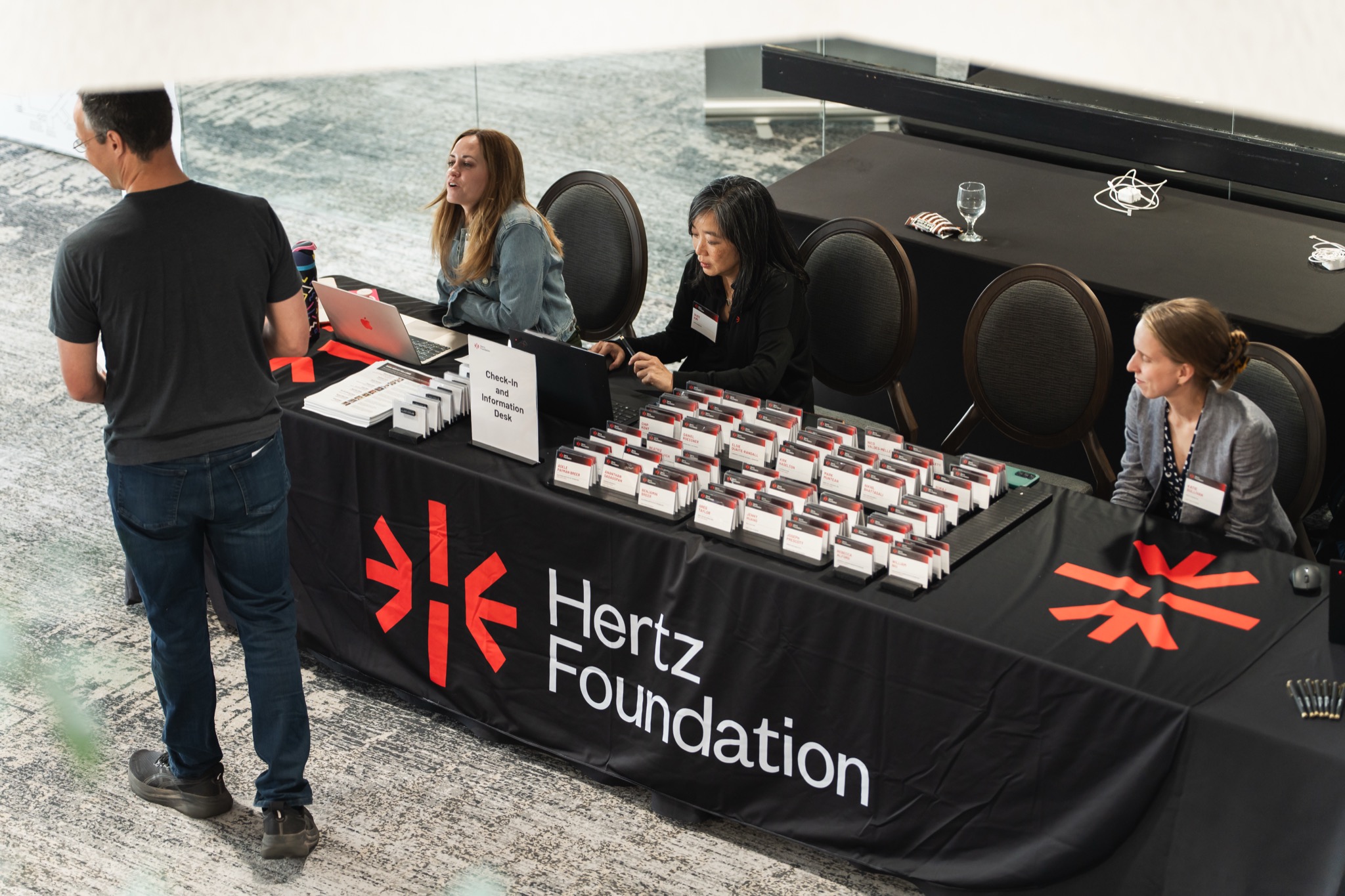
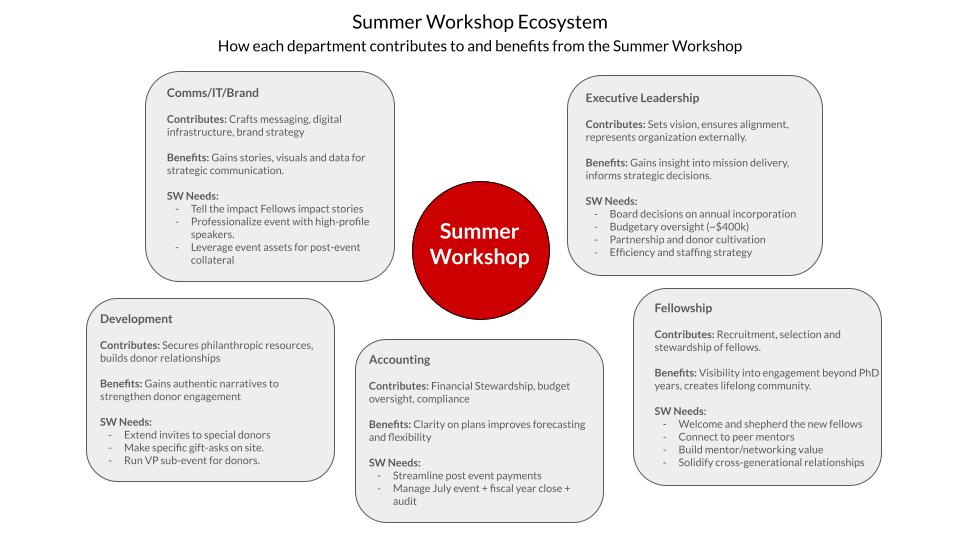
On the ground at the workshop, the distributed staff model becomes highly-visible: attendees at the 2025 workshop, for example, encountered an Executive Assistant to the President donning a pirate hat and acting as the emcee of the workshop’s Engineering Challenge among a host of other professionals (e.g., Director of Development, Senior Director of the Hertz Fellowship Program) contributing to workshop operations (from check in at the “info desk” to running microphones around the room, helping direct attendees to meals and sessions, and mingling throughout the event). The below image depicts the orientation of each functional group in the Summer Workshop Ecosystem.
Credit: Hertz Foundation
This revised distributed staff model was somewhat experimental, and therefore included some pain points and challenging outcomes:
Task-level vs. decision making-level: Although the shift toward having specific staff members assigned to each task helped to clarify roles and responsibilities, this clarity did not translate to decision-making structure. Staff members found it difficult to know when they did or did not have the authority to make a given decision.
Misalignment with regular job duties: As noted above, the summer workshop requires staff members to step out of their comfort zone into roles that are outside of their normal job duties and to do more work. Some staff members found this energizing, but others recommended putting additional effort into defining roles and matching staff members with tasks they are more naturally oriented towards. Additionally, staff felt that participation in workshop organizing came with a cost to their core job responsibilities.
Complexity and burnout: In some cases, it appears that staff felt overburdened by the demands of running a successful workshop and experienced burnout as the workshop date approached. Suggestions for alleviating this included hiring dedicated staff for workshop activities, constraining the timeline of workshop activities (e.g., starting planning later and/or ending it sooner), and minimizing the need for participation in last-minute decisions.
Evaluator Recommendations
We offer additional recommendations for improving the distributed staff model going forward:
Define and communicate decision-making structure/hierarchy: A significant portion of the negative experiences staff members had with the distributed staff model centered on not knowing if they could or should make a decision themselves. Creating, visualizing, and sharing a decision-making structure to accompany the process documentation would ease concerns about these decisions.
Hold conversations about reverse-engineering the job duties problem: Staff should ideally have autonomy over how closely their tasks in workshop organizing align with their regular job duties. Some staff may want fresh, out-of-the-ordinary tasks while others may not. For those who seek alignment, it would be worthwhile to flip the conversation: Rather than asking “which tasks align with your current job duties,” organizers might instead ask “how can summer workshop duties generate learning, productivity, and collaboration opportunities in your regular job?” This tactic may also help reduce burnout by providing autonomy and opportunities for professional development via workshop organizing participation.
Balance external capacity with staff involvement using a service model: We fully agree with staff feedback that the summer workshop is so large and impactful that it likely requires additional dedicated staff. We also believe, however, that staff participation is essential to bringing the event into alignment with the Hertz Foundation’s organization-wide mission, values, and goals. This event, in other words, might not be as intertwined with the fabric of the organization and its people if external or event-specific staff manage the entire process of organizing and running the workshop. Here, it may be worth thinking about a service-type model in which dedicated logistics support is hired to assist staff with carrying out the more burdensome aspects of their assignments.
Find opportunities for recognition throughout the year: Workshop planning begins long before the event itself, and some staff members mentioned that this lengthy process can be exhausting. Workshop organizers do an excellent job of recognizing staff effort at the event itself, but might consider finding ways to appreciate their work throughout the planning process. A monthly newsletter or other internal communication highlighting the work one or more staff members are doing to bring the workshop to fruition could be beneficial to morale.
Initiating a Fundraising Campaign
The Hertz Summer Workshop in recent years has had an elevated dinner at the end of the event to celebrate the year’s successes, discuss new initiatives, and communicate the status of the Foundation’s efforts. This year, the Foundation’s new fundraising campaign was a major component of the dinner. Highlighting the campaign served many purposes: encouraging past and present fellows to contribute funds to the Foundation, ensuring the community that the Foundation is on stable financial footing, and communicating how the Foundation intends to make a concerted effort to create new partnerships.
Reactions to the fundraising campaign announcement and presentation were mixed, but largely positive. A fellow from the late 2010s, for example, noted that the campaign announcement was “a little more intense” than previous calls for fundraising, citing a similar presentation at the San Diego Summer Workshop as a comparison. The fellow understood the need for this effort, however, and was supportive of the Foundation sending a stronger message on raising funds. He noted that the fellowship program has steadily improved its financial and resource support for fellows, and any initiative to continue this trend is welcomed.
A more recent fellow had a similar reaction and was surprised that an effort to increase donations made it into the workshop programming. He, too, understood the need and noted that “it’s always awkward to ask for money” no matter where or how you do it. He appreciated that there was time spent in the presentation to give the rationale for why present and former fellows should contribute what they could, although he felt bad that he did not have much money available to make a contribution. The presentation’s emphasis on “any amount” and the ways in which small donations add up made him feel included and put him at ease on the issue.
Others were more direct in their criticism of the announcement: As one survey respondent stated, “As an in-school fellow, it still feels very uncomfortable when the Foundation targets us for funding and donations. It’s not a positive power dynamic, in my opinion, and makes me less willing to consider donating to the Foundation in the future.”
A fellow from the 1990s we spoke with understood this sort of reaction from in-school and recent fellows, but added additional context for understanding why initiatives like this are so important. In particular, he pointed out that the Hertz Foundation has had financial issues during some periods in the organization’s history which put the program in jeopardy. He was encouraged by seeing the Foundation take a proactive approach to ensuring that such periods did not arise again and appreciated that the Foundation was forthright in its approach to communicating its fundraising efforts. Involving Fellows who understand historical context and hold institutional knowledge in storytelling efforts–providing context for the newer cohorts of Fellows–is a key component of the workshop and its impact on fostering a cohesive, cross-generational community.
Evaluator Recommendations
Our evaluators noted a few areas of improvement and recommendations for communicating about the campaign:
Release regular progress updates on the campaign: Hertz Fellows and other attendees are hard-working scientists on the cutting edge of their fields, so it is likely they will forget about the fundraising campaign in the course of their busy year. Re-energizing the community around the fundraising campaign will require regular progress updates, whether in written form, in webinars, or via video. Highlighting ways that the Hertz community can participate in the fundraising campaign in these communications will help individuals understand how they can contribute beyond donating their own money.
Ensure in-school fellows feel included: While younger fellows were complimentary of the way that funding was brought up, it’s worth being even more explicit about the realities of graduate student life and how contributions may not be possible today (e.g., messaging around making contributions in the future). The Foundation should also consider ways to get in-school fellows involved in fundraising even if they cannot contribute their own money, such as connecting them with potential donors to speak at their organization or participating in fundraising drives.
Introducing a Refreshed Identity: “Name a Challenge. There’s a Hertz Fellow Working On It.”
The Hertz Foundation, in an effort to modernize its branding and realign its community around common goals, introduced a refreshed identity throughout the 2025 workshop. The components of this identity included a new logo and messaging, both of which were fairly well-received among attendees.
New Logo
The Hertz Foundation logo has remained the same throughout the history of the summer workshop. As participants arrived at the 2025 workshop, however, they were greeted with a new logo on digital and printed signage, flyers and brochures, pens, and attendee gifts. We sought to understand participants’ opinions of this refreshed look and feel by (a) observing their reactions, (b) asking them directly in informal conversations, and (c) including a question about the new look in the post-event survey.
Participants were generally positive about the new logo. Survey responses, for example, indicated the following:
The new look and messaging are modern, bold, and inspiring.
I love it! Can’t wait for the website to be updated
Pretty dope
I think it’s nice we have a logo that’s not just the organization’s name
Some folks liked the logo, but remarked they didn’t immediately see the hidden H until later, suggesting that the video was helpful in seeing it.
Love it! I did not realize the embedded “H” in the icon, although it became clear in the video on Saturday.
I think it’s probably a necessary thing to get more visibility for the foundation. The logo looks better animated than static (makes it easier to see the “H”). The messaging seems reasonably dialed such that it is not a shift for the foundation.
Other attendees had no strong opinion about the rebrand, viewing it as an innocuous change that is reflective of broader trends in branding and marketing. There were some who simply had a neutral response:
Ho hum
Neutral; impact not clear
No strong feeling about the new logo
Nominally improved.
I didn’t really notice or tlak baout it.
No particular opinion on look. I think advocating for the importance of DTEM research and leadership in America is very important
For some attendees, however, the rebrand felt too reflective of these broader trends: In a breakfast conversation prior to a talk, for example, fellows from a late-2010s cohort discussed how the new logo appeared similar to AI-generated logos they had seen in other contexts. One such attendee went as far as to share a viral blog post humorously criticizing the appearance of these logos with other attendees.
The survey shared some of these critiques:
I personally preferred the old Hertz logo, and several other Hertz fellows voiced the same view
To be honest I was really confused by the logo at first, although it has grown on me somewhat. The shift towards a more corporate messaging style does concern me in that aligning an organization to be more appealing to industry donors does often introduce perverse incentives that interfere with the original goals and values of the organization. It remains to be seen to what extent the pivot towards industry funding will affect the directions and careers that fellows are steered towards and the culture of the community.
I am far more positive about the branding after seeing the video at the workshop; I have otherwise heard from other Fellows that they bemoan the loss of the Hz insignia, which had a lot of meaning for its scientific connection, and thought the new insignia was generic. The last is still true, but the other material may help alleviate that sense.
I wasn’t the biggest fan of the new logo to be completely honest. I felt like it looked a bit like the EMT logo or a basketball, but I can appreciate the logo after hearing more about the design intentions.
Looks like E*Trade logo
New logo is worse
Don’t understand why a new logo was needed
I’m not good with change, but this feels a little too modern/polished and less nerdy, science-y than before.
When asked if this new look affected their experience at the workshop, attendees remarked that the consistency of the overall experience outweighed any effect the rebrand might have.
New Taglines and Messaging
The Hertz Foundation’s new taglines and messaging were, on the whole, reviewed more positively by attendees than the new logo.
Attendees were particularly fond of the tagline “Name a Challenge. There’s a Hertz Fellow Working On It” and the associated digital displays highlighting innovative work being done by fellows. Their appreciation is reflective of a broader theme, one that we explore in the interim report and the present report: The Summer Workshop leaves attendees feeling connected to others who are working on highly-impactful, societally-important challenges. In our conversations and survey data from attendees past and present, we repeatedly heard that the event is an energizing experience, leaving attendees feeling motivated to make even more of an impact when they return to their workplaces. A large part of this energization comes from communicating science across domains, enabling each attendee to feel as if they are contributing to a broad and diverse but unified effort to improve the world via science.
In this way, the new taglines and messaging hit the mark in terms of authenticity to the Hertz community and in reinforcing the connectedness community members feel no matter how seemingly-unique their domain of expertise might be.
This messaging seemed to resonate well with fellows:
I like it! Spreading the word about what Fellows are doing and where they work at after grad school is really powerful.
It’s fine. “Let’s make history together” is a good line.
I generally think “look and meaning” discussions are a way to avoid critical topics, but like the new logo and mission really speak to me.The messaging is good, but the logo really feels start-up/Silicon Valley rather than academic. The old hertz logo font was similar to the one used in LaTeX and to most academics is instantly recognizable. With the new logo, it looks more like a VC funding firm or a startup if you glance at it on a slide.
I strongly agree with the new messaging, but I did hear a few comments from people that weren’t 100% onboard with the American/military focus.
Love the slogan (where there’s a challenge...)
I think the messaging is great…
Evaluator Recommendations
Lean into the new tagline, “Name a challenge. There’s a Hertz Fellow Working on It”: The new taglines and initiative to highlight the major societal challenges Hertz fellows are working on were the best-received aspect of the refreshed identity. The Foundation should consider ways to build upon this reception. Possible ideas include documenting and categorizing challenges and the fellows working on them via a navigable website; encouraging fellows to submit their own profiles for challenges they are working on; and making the visual displays of profiles a permanent presence at the summer workshop.
Offer scientific communication guidance using the Hertz Foundation’s expertise: We repeatedly heard fellows discussing their desire for help with building scientific communication skills. This ongoing discussion arose because fellows at the workshop were actively recognizing connections between their own work and societally-important issues, yet realizing they did not know how to effectively communicate their impact to the public. The refreshed identity taglines and profiles demonstrated how this type of communication can be done, and the Foundation actively works on its scicomm approaches in cultivating new donors and partnerships. Finding ways to syngeristically teach these scicomm approaches to fellows would be a welcome improvement for the community.
Launching the Pilot Matching Program
The 2025 workshop’s new elements included the pilot of an AI-generated attendee matching tool in which attendees received a list of five people to meet during the workshop. The algorithm used attendee names, LinkedIn profiles, and bios to generate the suggestions. Attendees were able to access their suggested recommendations via the event agenda, and all recommendations were visible to the entire attendee list.
Perceptions of the matching program were mixed: Survey responses indicated that some attendees sought out their connections and appreciated having a natural way to introduce themselves; others thought the program was a good idea, but they already knew their connections or met them without consulting the recommendations; and others ignored the recommendations entirely, noting that there were already plenty of opportunities to meet new people.
The survey asked if attendees had met up with their recommended connections. Many did connect, but some folks mentioned they would likely have talked to these people even without the program or that they had already been connected to the folks they were assigned:
Two of them. I would have talked with them, anyway.
Yes, it went great, but I probably would have spoke to them anyway.
I ended up speaking with most of my connection recommendations before I even looked at the spreadsheet!
I knew them already :) so we already chat/have chatted outside of these connections
Some did indicate that the program helped them break the ice:
yes, I did! Four of my five connections were people I already knew. The fifth was someone I did not, who was a bit of a shy person and this definitely helped break the ice. We had a long and excellent technical conversation and I think it was really valuable in that regard.
I did, it was great. I had an hour long conversation with atleast half of my connections!
Yes, it was good, and gave me the opportunity to speak to someone I might not have naturally chatted with.
Others had trouble, didn’t think the suggestions were helpful or indicated that there might be other ways to help them find each other:
Some... Too hard to find all of them...
I did speak to several of them. It was ok. It might be better to put those folks at a dinner table together.
Yes, but most were not as relevant compared with other connections I made
Some weren’t able to find their connections or simply didn’t feel motivated to find and talk with the people they were assigned:
Yes, but incidentally. Not really motivated by the recommendations.
Alas I did not. without dedicated time to connect with those people, it was too hard to find them!
No, because I was a plus one, and it seemed like people were primarily there for helpful career connection
The AI recommendations were kind of subpar; 3 of the 5 people were the 3 fellows I talk to most already. Secondly, all the fellows I matched to were in-school. I wish there were an explicit constraint to meet at least one older fellow.
The 5 connections was a great idea but should have included a better way to actually find your 5 recommendations... e.g., “these 5 connections... meet at this location at this time”
Evaluator Recommendations
The pilot was successful as an experiment and will likely become increasingly valuable as the size of the community grows. There are several opportunities for improvement:
Communicate how pilot matching recommendations were generated: Given that the summer workshop brings together a community of scientists, many attendees were interested in learning how the recommendations were generated. Describing the input data would help attendees appreciate the recommendations and whether they were made for simplistic (e.g., similarity of first names) or more complex (e.g., shared interest in a hobby) reasons.
Offer opportunities for attendee input: Attendees arrive at the workshop with all sorts of networking goals, from finding new collaborators to exploring new sources of funding for their work. The algorithm could take these goals into account with short surveys or email prompts asking attendees what their networking goals for the workshop may be.
Incorporate career stages: Several attendees we spoke with throughout the workshop expressed a desire to connect with fellows from different career stages. Senior Fellow or retired attendees, for example, noted that the sheer number of people they had met over the years made it difficult to balance reconnecting with meeting new people. Making connections across cohorts an explicit goal of the matching program would likely be well-received.
Partnership Breakout Groups
The Hertz Foundation is, as part of its fundraising campaign and general approach, actively seeking out new partnerships with companies and other organizations involved in the science and technology spaces. The 2025 workshop included three partner-hosted breakout groups to begin forging opportunities for partners to participate in the workshop going forward. Reception to these breakouts was mixed, with several key criticisms from attendees:
Advertised breakout topics did not align with the discussion: In at least two cases, the title and description of the breakout in the workshop agenda did not fully align with the actual discussion and activities. Attendees expressed frustration that they attended one over another based on the description.
Community members were skeptical about partner interests: Many attendees felt that some of the partners had questionable interests:
“The large platform given to [industry partner] felt odd and out of place. ... Also, they don’t bring any good to the world or help solve any intractible problems. It felt suspicious. Yes, plenty of STEM people end up working [in this industry] because they can’t get a job in their field, but I don’t think Hertz needs to offer that plan B up so readily. Hold Hertz fellows to a higher standard.”
Attendees felt at least one of the breakout discussions was too adversarial: Attendees in one breakout session described how the breakout organizers were somewhat condescending in their discussions about the future of their particular industry and other scientific topics. They felt that the partner did not fully understand the norms of scientific discourse within the Hertz community.
These partnership breakouts and partner attendance in general will be a valuable tool for cultivating donors going forward, in addition to the more explicit goals of providing new and different content and opportunities for fellows across career stages. Workshop organizers should treat this year’s experience as an experiment, seeking to learn from attendee feedback and include fellows a bit more in the selection process.
Evaluator Recommendations
Consider the Hertz Community’s insularity when choosing workshop partners: Throughout the workshop, we heard quite a bit of hesitancy about the presence of industry partners. Some attendees we spoke with did not understand why industry firms were in attendance; furthermore, some attendees mentioned that the industry firms were actively recruiting on their university campuses, prompting them to feel like the firms’ attendance was extractive and exploitative. Workshop organizers should consider how to better communicate why a partner is present. It would have been helpful, for example, to highlight that a Hertz Fellow works at the partner firm and that all fellows are welcome to suggest potential partners in their networks. Such an approach would protect the desired insularity of the Hertz community while signaling that fellows take a variety of career paths, and those paths are important to represent at the workshop even if they are not traditional science enterprises.
Prepare breakout partners for the culture and environment of the summer workshop: The staff and volunteer debrief sessions following the workshop indicated that partners holding breakout groups did not receive the same primers and coaching as other speakers at the event. This lack of preparation was clear to attendees at two of the breakout groups: The partners running the breakout did not fully grasp the norms and approaches of scientific debate in these settings, leaving some attendees feeling disparaged and unhappy with the experience. Preparing partners for what to expect, and perhaps including a Hertz-provided facilitator, might help in making these breakout groups run smoothly.
Embrace the spirit of playfulness: One of our evaluators attended an engaging breakout group, which centered around an “estimathon.” Each table received an estimation problem and submitted answers that were scored for their accuracy/precision by the industry partner team. Attendees universally enjoyed this activity. Encouraging partners to align the breakout structure with the community’s appetite for games and challenges would likely serve the interests of all parties (the Foundation, the partner, and the community).