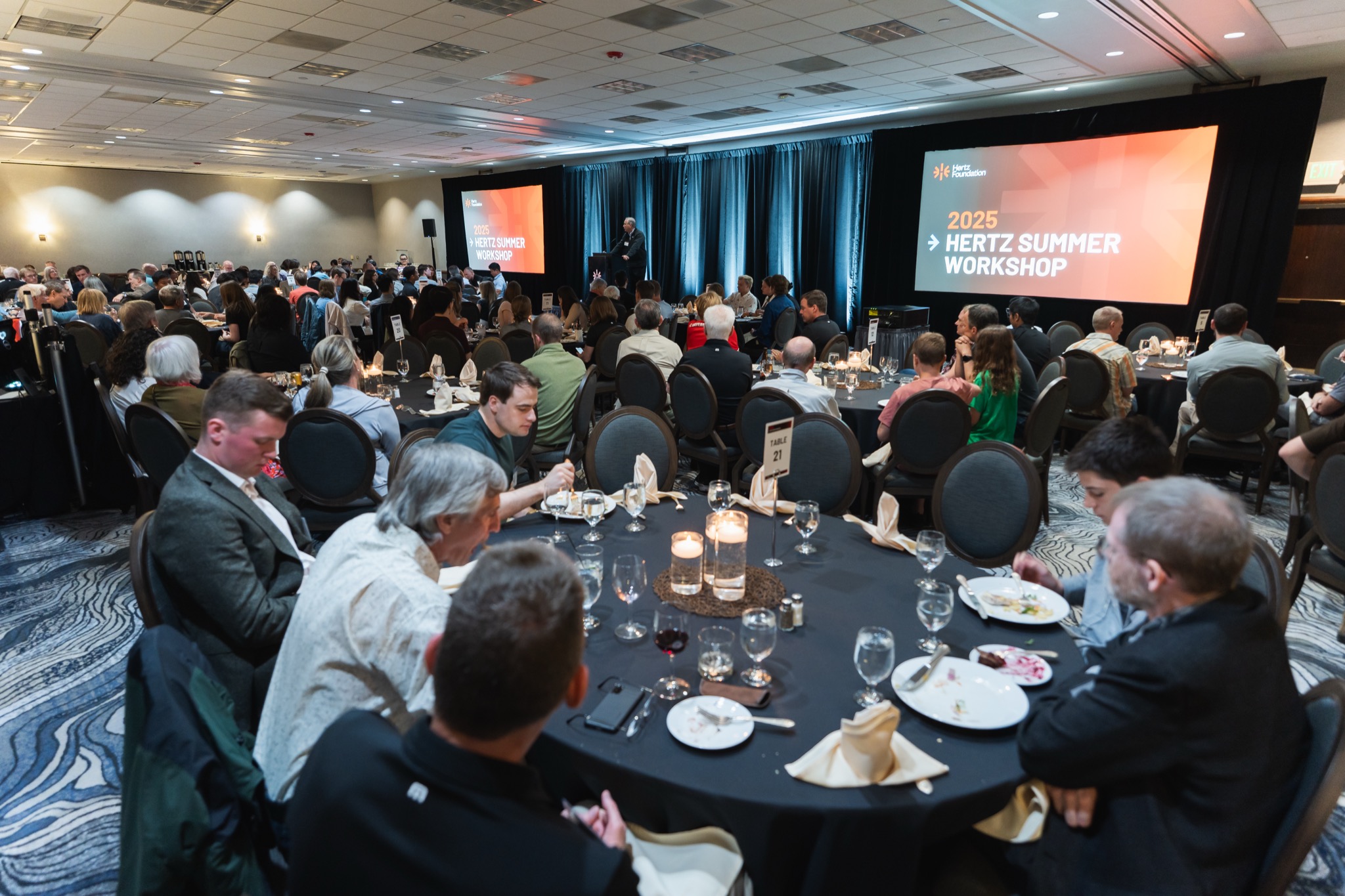
Credit: Hertz Foundation
The Value of Attending a Summer Workshop
The Hertz Summer Workshop is a “collider” event where scientists from a variety of disciplines come together to share their work, find new collaborations and funding, and strengthen their networks. This was evident in the interim report, but even more after being on the ground at the summer workshop enabling the evaluation team to dive deeper into the value of the workshop and providing additional evidence that it is a critical component of the fellowship program and Hertz initiatives more broadly.
Connecting to Society’s Biggest Challenges
Scientists often work in isolated environments: At the individual level, they may toil away in their labs or at their fieldsites by themselves or with a small group of close collaborators. At the group level, disciplines rarely get the opportunity to interact with one another (with the exception of closely-related disciplines, such as chemists and molecular scientists). What keeps them from interacting across disciplines in dedicated settings, such as the summer workshop? There are multiple reasons:
Scientists have a hard enough time keeping up with new work in their own fields, given the speed and volume of research;
Disciplines have differing “languages” that reflect their orientation toward methods, data, ethics, underlying assumptions and principles, and fundamental goals;
Disciplines operate on a cadence of regularly-scheduled conferences, meetings, data collection periods, and other temporally-bound activities, making cross-disciplinary events difficult to schedule and convene.
The Hertz Summer Workshop addresses each of these challenges in a unique, community-forward way. The event, in many ways, is what holds the Hertz community together and creates an environment that feels very much like its own “discipline.” Being on the ground at the 2025 Summer Workshop provided the opportunity to analyze how workshop organizers manage to create such an environment and the value it delivers, particularly helping to understand why top-notch scientists choose to attend the event each year and sustain their commitment to the community.
The key value the workshop provides, in our estimation, is the opportunity for individual scientists to connect their work to society’s biggest challenges and celebrate each other’s progress toward solving these challenges. The workshop provides the space and appropriate structure to share progress in attendees’ scientific domain, learn about what others are working on, and identify the common mission and values that underlie seemingly disparate workstreams. Workshop organizers facilitate this connection to a broader mission and shared values by inviting speakers whose work is both accessible to all attendees and societally-important; by highlighting what connection within the community can enable in terms of collaboration and support; and by encouraging “parallel play,” where scientists get the opportunity to engage with one another on a level playing field (i.e., creating an environment where individuals are equally out of their comfort zone, yet retain autonomy over whether/how they engage with others).
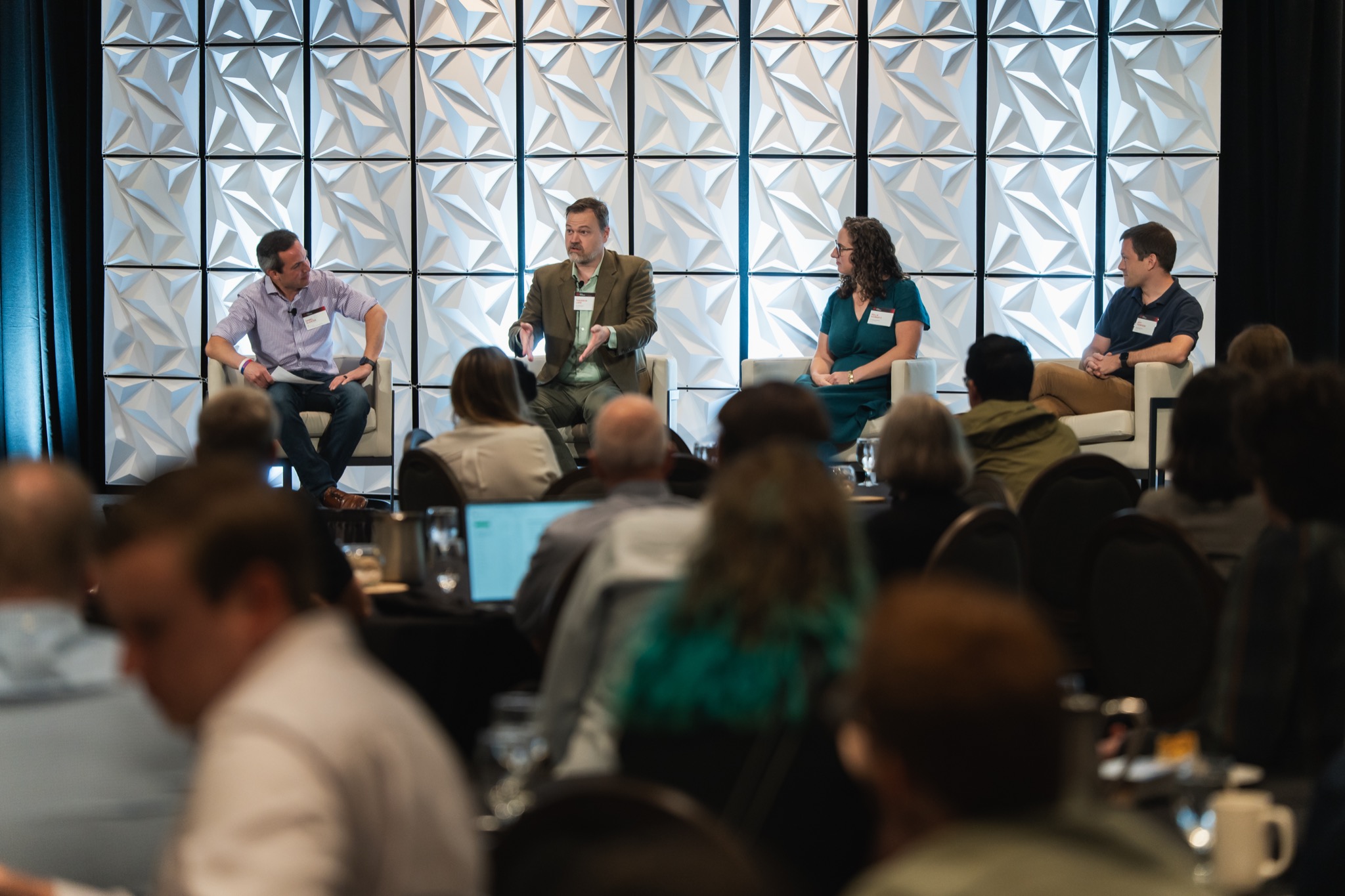
Credit: Hertz Foundation
Speakers and Talks
The Hertz Summer Workshop is the exemplar of how cross-disciplinary scientific communication should work: Having attended hundreds of scientific meetings across our evaluation team, we rarely see scientists engaging with one another on technical topics in such productive, generative, and healthy ways, especially when the community is made up of scientists with diverse training and expertise in different fields. Scientific meetings too often take the form of massive and repetitive lectures about polished research products rather than places where the realities of science are shared and discussed in empathy-building and community-building ways.
The uniqueness of the workshop’s scientific community model was evident in the balance of consistency and variety of talks in Colorado Springs. The talks, with one exception, remained accessible and understandable to all of the attendees we gathered feedback from, an impressive feat given the range of represented topics and disciplines. Likewise, each talk had elements that are informative beyond academic science, something that stands out from typical scientific meetings. Attendees from the industry, government, defense, and non-profit sectors found value in learning about the state-of-the-art in each speaker’s given field, reinforcing the community’s shared mission and values. For this reason, we attempted to identify the core attributes of a Hertz Summer Workshop talk in hopes that the model can be articulated, shared, and celebrated as something that the Foundation and workshop organizers excel in putting together.
Attributes of a Summer Workshop Talk
Because talks at the Summer Workshop were somewhat different than other academic conferences, we worked to evaluate how these talks were unique and identified a few common attributes that we think are distinct from other types of workshops:
Summer Workshop talks are accessible: Workshop talks take deep dives into an area of scientific research that the speaker is conducting, not unlike disciplinary conferences. However, in contrast to disciplinary conferences, summer workshop talks are accessible to a much wider variety of scientists because:
Speakers are explicitly asked to define their terms: Panel moderators asked all participants to define any specialized language and interrupted when necessary to ensure everyone could follow along. Speakers and panel moderators also provided pre-talk/conversation primers when needed to make the conversation more accessible to all (e.g., before the quantum computing panel, the moderator delivered a primer on the history and current state of the field).
Speakers draw upon common base languages: When talks veered into technical details, speakers adeptly used words, phrases, and visualizations that are common across many scientific disciplines. Mathematics was the base language that appeared most often, evidenced in several attendees comparing the workshop to “math camp.”
Exceptions and violations of these norms are immediately recognizable to the community: At the 2025 workshop, at least one talk veered into highly-specialized discussion of an important but niche scientific topic. Attendees whose work is not closely related to this topic found the talk disengaging, as evidenced in both observations, subsequent discussions, and the post-event survey. That said, there were more questions than could be answered at the Q&A and the speaker was highly sought after by attendees for conversation throughout the workshop.
Summer Workshop talks share the realities of doing science, not just a finished product: Most talks included the messy, non-linear story of how the work came to be, the challenges the investigators faced, and the workarounds they developed to accomplish their work. Some talks are dedicated entirely to sharing the story of how science is done, such as a talk that described the experience of working in a high-level biosafety laboratory. Speakers often supported these realistic depictions with pictures, videos, and other immersive media.
Summer Workshop talks highlight tools that are unique to their field: Scientists are often overly-familiar with the tools (e.g., software, devices and equipment) used in their own discipline, so descriptions of these tools often don’t make it into their talks. The Hertz Summer Workshop gives attendees the opportunity to teach and learn about unique tools that may be interesting and/or useful for attendees outside of their discipline. This feature also results in some speakers bringing along physical artifacts used in doing science (e.g., tools for gathering sediment from riverbeds), which adds to the playful and camp-like atmosphere.
Summer Workshop talks are candid about possible moral, ethical, political, and social pitfalls of science: Whereas disciplinary conference talks often assume attendees are aware of these pitfalls, Hertz Summer Workshop speakers treat them as something to be highlighted and discussed rather than hidden. This attribute helps attendees identify and discuss variations in potential pitfalls. When necessary, talks and panels are explicitly made “closed” or placed under Chatham House Rules to ensure that speakers can be candid and honest in their delivery. This feature has the knock-on effect of making the event feel like a prestigious event that comes with requisite moral and ethical responsibility, reflecting the Foundation’s four brand pillars (“awesome responsibility,” “freedom to innovate,” “prestigious reputation,” and “interdisciplinary community”). All four of these brand pillars become obvious when observing the ways the community trusts one another to hold these conversations at the workshop.
Summer Workshop talks have thoughtful, engaged, and balanced Q&A: Hertz Summer Workshop attendees were highly engaged during the Q&A part of the talk, sometimes even more engaged than the talk itself. Every talk resulted in more questions than could be answered in the allotted time, but organizers managed the time well: Attendees were able to engage in back-and-forth with speakers to satiate their curiosity without taking up too much time for other questions. In particular:
The questions themselves ranged from deeply knowledgeable “inside baseball” questions between scientists of the same discipline to broader, connective questions between disciplines. The informal community norm of prefacing their questions with a comment about the questioner’s background (e.g., I am not in this field, but I am familiar with ________) enabled the speaker to tailor their answers to the appropriate level. This norm could benefit from a quick but informative addition of the speaker’s name and affiliation. Across these different Q&A dynamics, every attendee appeared to recognize the community value of sharing as much information as requested and continually striving to connect answers to other fields.
One attendee mentioned that they tended to pay attention to the Q&A portion of the talks in order to figure out who they would like to talk to at the event. The Q&A time, in other words, served as a method of learning about others’ interests and finding possible collaborations or networking opportunities. This element of talks was only possible because of the community values and norms described above; only in one or two instances did a question turn into a prolonged 1:1 back-and-forth or a “monologue” by the questioner.
We learned from workshop organizers that some volunteers and/or staff feel that “microphone runners” sometimes introduce bias into the Q&A process. They suggest that runners might, for example, favor friends or colleagues in selecting folks to ask questions (and therefore augment or inhibit attendee’s visibility to the rest of the community). We did not observe this firsthand or hear any concerns from attendees, but it is worth considering how to “randomize” the Q&A selection process.
Indeed, for many attendees, the talks and panels are the highlight of attending the workshop. A sampling of survey responses to a question asking what attendees enjoyed most confirms this sentiment:
Truly stellar speakers, especially the biosecurity panel and Doug Wickert.
The talk by Brig. Gen Wickert.
Hertz Fellow Lightning Talks
Thursday Keynote [Arnold Levine]
Panel discussion on Quantum Technologies.
When asked what they would change about the workshop, survey responses indicated a desire for more talks:
More talks! I’d like to have more long-form scientific talks. I think particularly for the panels, it would be great to have an opening talk rather than just a panel on its own.
I’d like to see more applied physical sciences talks (not academic talks), esp. fusion industry, quantum industry
I would appreciate more talks from in-school fellows (or just more talks in general). They were all so good and I wanted to learn more about what everyone is working on.
More off-the-record open panels similar to what was done at this year’s workshop
In past workshops we had more talks during mealtimes, which I enjoyed
Maybe 1 more “high-profile” speaker
The value of talks is augmented even further by the accessibility of speakers for 1:1 or small group discussions throughout the weekend. Survey respondents were asked if they had the chance to engage with any of the speakers, and all responded that they had spoken with at least one speaker (many with multiple speakers). This suggests that there is a clear culture of engagement and conversation among speakers and attendees.
Sharing “Awesome Responsibility”
In addition to the attributes of the talks, the content itself prompts attendees to come away from the workshop feeling like their work is connected to society’s biggest challenges. Workshop organizers intentionally select speakers whose work addresses challenges to health, the climate, geopolitics, the economy, and other large-scale issues, which enables attendees to connect their work to diverse and far-reaching impacts. Attendees we spoke with indicated that simply being in the room for discussions with experts on these topics left them with a renewed sense of importance for their own work and careers.
Themes in post-workshop survey responses illustrate this new or renewed connection of attendees’ work to societal challenges. We asked respondents to complete the sentence, “After participating in the summer workshop, I feel more of a responsibility to_______” and the following themes emerged:
Bigger Picture
Position their work in “the bigger picture”: Attendees noted they felt a responsibility to connect what they were doing in their labs to real-world impact. These motivations included taking on “moonshot problems” and serving the national interest, and a sensitivity toward understanding unintended consequences.
Some answers from the survey:
Use my scientific skills in service of the national interest.
work to solve the world’s problems with others in this community
(I LOVE this question) deeply consider the impacts and unintended consequences of my work.
Make sure that my work and career have positive societal impact
change the world
The Future of Science
Take pride in (and responsibility for) science’s reputation and future: Threats to the future of science and science funding was an undertone to many conversations at the workshop.
Survey results and intercepts indicated that the workshop energized attendees to take responsibility for overcoming these challenges, including mentoring the next generation of scientific leaders:
communicate the importance of my work as a scientist to the general public and advocate for stable science funding.
be true to who I am and the good I can do.
Mentor younger fellows
act as a role model and mentor younger generations of scientists
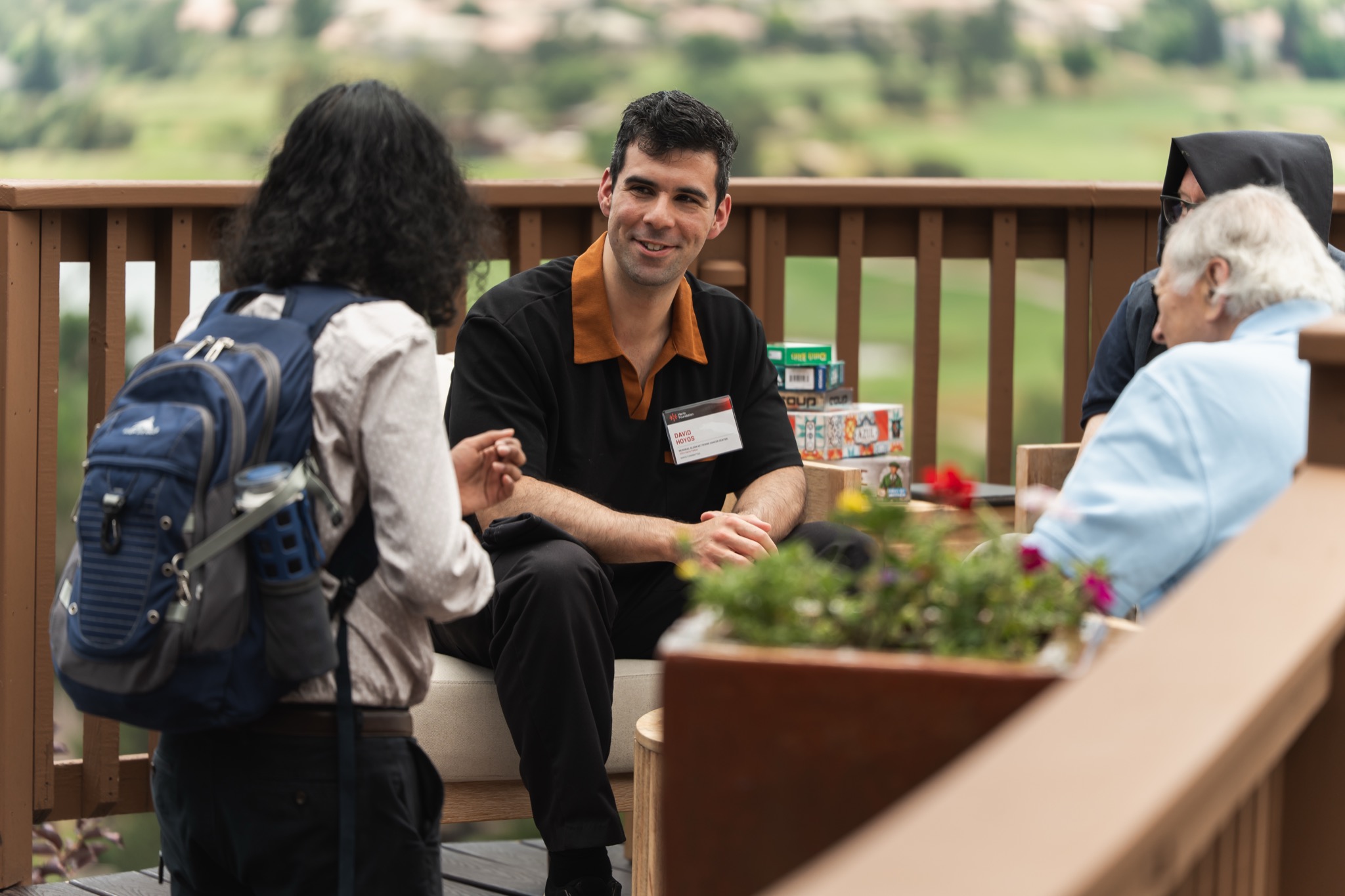
Credit: Hertz Foundation
Hertz Community
Recognize the Hertz Foundation’s impact on science and the value of the Hertz Community: Several respondents noted that the workshop helped them understand why the Hertz community of scientists is important to sustain. Likewise, responses indicated that they felt more of a responsibility to sustain Hertz’s impact by getting more involved with the Foundation’s efforts beyond attending the workshop:
Volunteer to help in more ways.
maintain connection with the Hertz Foundation
Be a steward of the foundation
stay connected with the Hertz community during the year.
The shared responsibility Hertz fellows feel for stewarding science and its public impact is a unique aspect of the community. Individual scientific disciplines often emphasize narrow focus and a “lane” for its community members; when attending the workshop, fellows feel a greater sense of purpose and a desire to contribute to solutions rather than simply developing theories and publishing academic papers. This shared purpose translates into robust network-building, development of new scientific communication approaches, impactful collaborations and mentorship, and enhanced career trajectories, all explored below.
Building Resilience and Preparing for the Future
In assessing the value of the workshop to attendees, we also sought to understand what attendees felt better prepared to do after leaving Colorado Springs (or, in a few cases, when returning back to work in Colorado Springs). The primary theme in these responses centered on feeling more resilient and adaptable to change via strengthened networks, improved scientific communication skills and comfort, ideas for new collaborations, and learning new domains of science.
Strengthened Networks
The summer workshop strengthens attendee networks inside and outside of academia:
Survey responses and intercepts indicated that attendees felt they made connections to new domains that made their network stronger and more prestigious. All attendees come from relatively high-prestige organizations, colleges, and universities, as evidenced by clear and casual display of status indicators (e.g., university or company clothing, backpacks, mugs, stickers, etc.) and ubiquitous discussions about working in these environments.
The value of being part of such a network was evident in responses to questions about what attendees felt better prepared to do and how being a fellow affects their professional reputation. Attendees answered as follows:
It is a highly respected achievement in many circles that opens doors.
Giving me credibility, confidence, and a powerful network
adding credibility, interdisciplinary thought, and curiosity to my name.
Indicating that people should take my ideas seriously.
adding an unparalleled level of prestige
I feel more confident networking with industry professionals--the Hertz community is a nice way to get a feel for how that world works without having to completely leave the academic bubble.
Scientific Communication
The summer workshop improves attendees’ scientific communication skills:
As noted above, the structure and content of summer workshop talks is an example of excellent scientific communication practices. The talks and ongoing interactions with other disciplinary scientists throughout the workshop enable attendees to develop new skills and approaches for communicating their work, something that leaves them feeling prepared and resilient:
I feel more prepared to communicate my work to a more general (but technical) audience, take opportunities from the networking I did at the workshop, and think about interdisciplinary overlap with my work.
Collaboration and Mentorship
The summer workshop opens up new collaboration and mentorship ideas and opportunities: Surveys, intercepts, and informal conversations indicate that workshop attendees can and do find new collaborators and mentors within the Hertz community, with the workshop being a key place for exploring these partnerships. Interdisciplinary collaboration opportunities, in particular, were a prominent theme–given that scientists so rarely get to communicate their work outside of their field, attendees relished in the possibilities that could come with working alongside other Hertz community members:
Work with others in the Hertz community/reach out to them; work on interdisciplinary problems
Collaborating with other fellows to form connections and collaborations.
There was a clear sense from talking to attendees that mentorship among fellows was central to the summer workshops. Senior Career fellows talked about how much they enjoyed being able to engage with and support junior fellows. One fellow who had been a part of the interviewing process for the current class of incoming fellows talked about how excited he was to have conversations with the new fellows and to talk to them more about his work. During the interview process it wasn’t appropriate to create a deeper connection and he looked forward to being able to engage with them further.
Another fellow who had graduated in the 1990s talked about how nice it was that this kind of mentorship was available and how she wished they had been able to have this when she was starting out in her career. The fact that it was available now was inspiring to her and she wanted to make sure this culture of mentorship was available going forward.
Fellows who were still in school seemed responsive and welcoming to the support and mentorship, noting that they felt they could come to people and talk to them and that they were forming connections with people who genuinely cared about their work and their well being. One in-school fellow mentioned he was feeling stuck in his work and that it was really helpful to grab someone who was in his field, and more advanced in their career, to talk about his research.
Cutting Edge Science
The summer workshop challenges attendees to stay on top of cutting-edge science: The workshop’s value in helping and motivating attendees to learn about new scientific frontiers was a unifying sentiment across career stages and fellows’ ages. Older fellows, for example, expressed delight at getting to learn what the newest cohorts of scientists were working on and how methods and approaches have changed over time. Junior fellows enjoyed learning what was going on outside of their specific domain and anticipated learning more about technologies and approaches that may soon be relevant to their field, keeping them ahead of the curve:
Get a better understanding of quantum computing.
I feel a renewed interest in my work
Thinking about different problems people are tackling that are not relevant to my field
Career Pivots
The summer workshop enables career pivots: The cumulative effect of the above points is that summer workshop attendees feel more comfortable navigating any changes or challenges they encounter. At this year’s workshop, the topics of career transitions and pivots were top-of-mind for many attendees: Several early career fellows who are still in graduate school or who are about to finish their PhDs were somewhat anxious about their careers given political and economic shifts, prompting them to actively explore what they might do next if academic jobs are less available. This topic was central to their discussions with each other and with older fellows. We heard fellows debating the merits of going into industry versus academia; talked with fellows who had made a decision and were trying to network connections for their new needs; and overheard conversations about how career anxiety seemed “different this year.”
From these conversations, we heard that:
Connection to other fellows acts as a navigation tool by making career options and pathways visible and discussable.
Support for alternative careers is available in the Hertz community, and can even lead to financial support.
Peer-to-peer interaction and career updates helps to demystify the process of advancing throughout one’s career, no matter the career stage.
At the workshop, evaluators observed one fellow connecting a peer with a venture fund for their new startup. During one of the breaks before a meal, two fellows were talking, one was explaining his idea for his startup, the other fellow mentioned that she had someone she wanted him to meet, especially after hearing his startup idea. She happened to see that person walking by and introduced them during the break at the summer workshop. She mentioned to both of them that their scientific interests overlapped. She and the evaluator kept talking about other topics; minutes later, that same fellow returned to say thank you to her for the introduction and that he thinks he might have a potential new investor in his work. He thanked her for seeing the similarities in their interests and making the connection.
Attendees’ positive experiences in leaving the workshop feeling better prepared and more resilient to the challenges of doing science were not entirely universal. For some attendees, attending such a prestigious meeting was cause for reflection. Their Hertz Foundation affiliation may not be as impactful in industry as it is in academia, for example. And even where the prestige of the fellowship is recognizable, it may be perceived as elitist.
Responses to how the fellowship affects professional reputation included:
It was very important at my mid-career point. It provided credibility for my work and my recommendations. As time went on, I value it still, but my peers are less swayed by it.
burnishing my credentials, but also makes me conscious of people thinking I am elitist
I hope to learn the answer to this when I apply for jobs in the next year.
not sure. In the business world, it is less known than in academia.
gaining respect from those who know (those who don’t confuse with the car rental company).
Despite these concerns, our evaluation concluded that the benefits of the workshop for one’s perceived responsibility and career trajectory largely outweigh any drawbacks. The summer workshop helps bring the benefits to the forefront via connection to peers, enhancing the Foundation’s reputation and the pride its community members feel in belonging to such a group.
Evaluator Recommendations
Continue highlighting the strengths of the Hertz Foundation community when marketing the Summer Workshop: The Hertz Community is a rich group of scientists with diverse expertise. Attendees were clear that the value to them was found in the talks, a chance to talk with other scientists, discussions across fields about the big picture and future of science as well as building resilience within the Hertz community.
Consider adding more talks at future summer workshops: Attendees seemed to want more talks at future summer workshops. Consider sharing this report and the attributes of a summer workshop talk with future speakers as a way of helping them understand the unique attributes of this meeting as it is unique.
Select speaker liaisons carefully: The notable exception to talk accessibility prompted the evaluators to think about ways to ensure talks remain accessible. One recommendation is to match speakers with liaisons who are not formally affiliated with or collaborators of the speakers, particularly when the liaison is in a junior position. Inherent power dynamics may deter the liaison from speaking up about the accessibility level of the talk in ways that might not be as awkward with a non-collaborator.
Formalize mentorship opportunities for fellows at the summer workshop: Even with an informal and collegial mentorship we experienced at the summer workshop, we saw in the survey and heard in conversations a desire for more formalized mentorship.
Early career fellows seemed to desire guidance, support, and mentorship from Senior Fellows, and Senior Fellows seemed keen to offer their insights. We heard from some mid-career fellows who were leading groups in small or remote universities that they were coming to the workshop to find more connections and network as they were facing budget challenges, tenure and promotion stress, and other issues that mentorship could aid in addressing. And nearly all Senior or retired Fellows discussed their desire to mentor and help younger fellows navigate their careers.
Possible options mentioned by attendees included:
“More local events in major Hertz areas.” and “More Hertz local meetups would help foster stronger connections --- for example meetups at a restaurant, bar, or coffee shop; going on a hike; etc.”
“I think better fine-grained search for things like “who has changed careers” or “who can help me learn how to start a business” or things like that among the Fellows directory, to be able to reach out and make connections.”
“It would be good to have or have and know about online fora maintained by the Foundation that Fellows could visit and share ideas.”